Beyond the Screen: Why Your Classroom Tech Might Be Failing Your Students (and How to Fix It)
This blog post explores the SAMR model as a framework for moving beyond mere technology use toward transformative techno-pedagogical integration. It details the transition from enhancement (Substitution and Augmentation) to transformation (Modification and Redefinition), illustrating how intentional instructional design can foster higher-order thinking skills and maximize student participation in the 21st-century classroom.
S B Choudhary
5/8/20244 min read
1. Introduction: The High-Tech Illusion
Walking into a modern classroom, we are witnessing a paradox of saturation. Tablets are ubiquitous, and interactive whiteboards glow in every room, yet learning outcomes frequently remain stagnant. This "high-tech illusion" masks a deeper digital pedagogy gap: the presence of advanced tools does not inherently change the underlying teaching method. To move beyond mere "tech use" and toward true integration, educators need a strategic roadmap. The SAMR framework serves as this guide, acting not just as a classroom model, but as a pathway for measurable professional growth. By climbing this ladder, an educator transitions from a "fresh teacher" into a sophisticated "techno-pedagogue," capable of using technology to catalyze rather than distract.
2. The "Shiny Object" Misconception: Content Must Outrank Tool
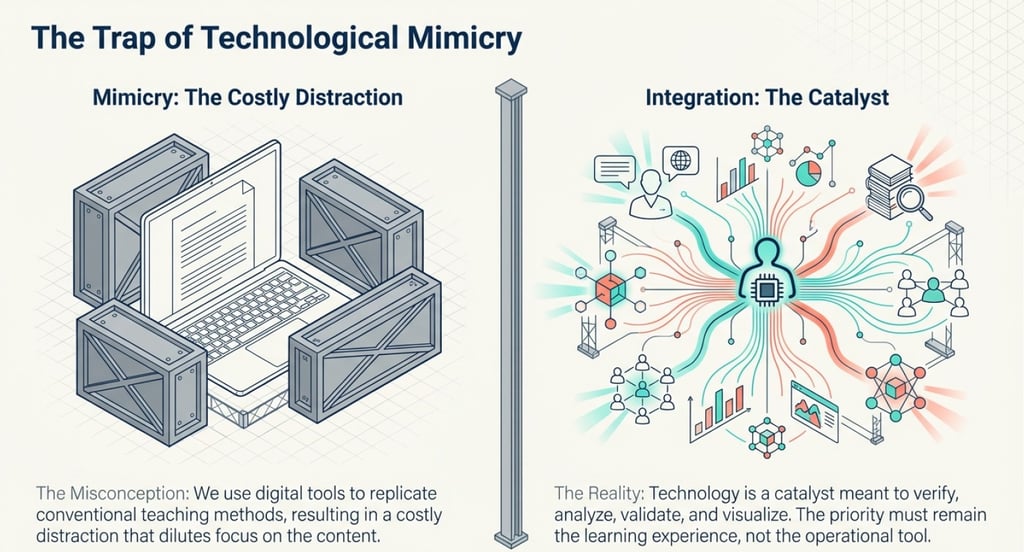
A frequent error in modern instruction is prioritizing the "shiny" tool over the curriculum. It is easy to be dazzled by an app’s interface, but prioritizing technology over content violates the core tenets of NEP 2020, which emphasizes that the curriculum must drive the medium. When teachers use technology simply to mimic conventional methods—such as scrolling through a digital PDF as if it were a paper textbook—they fall into a trap of missed opportunities. This occurs because many educators "never bother about the scope or potential of the media" they are using.
Technology should never be a "costly distraction"; it must be a catalyst for experiential learning. As the expert reminds us:
"Technology is only a tool in the hands of the teacher and the teacher need to decide which technology tool for which content which time and for what purpose and how will I make maximum participation of the learners."
3. Crossing the Invisible Line: Enhancement vs. Transformation
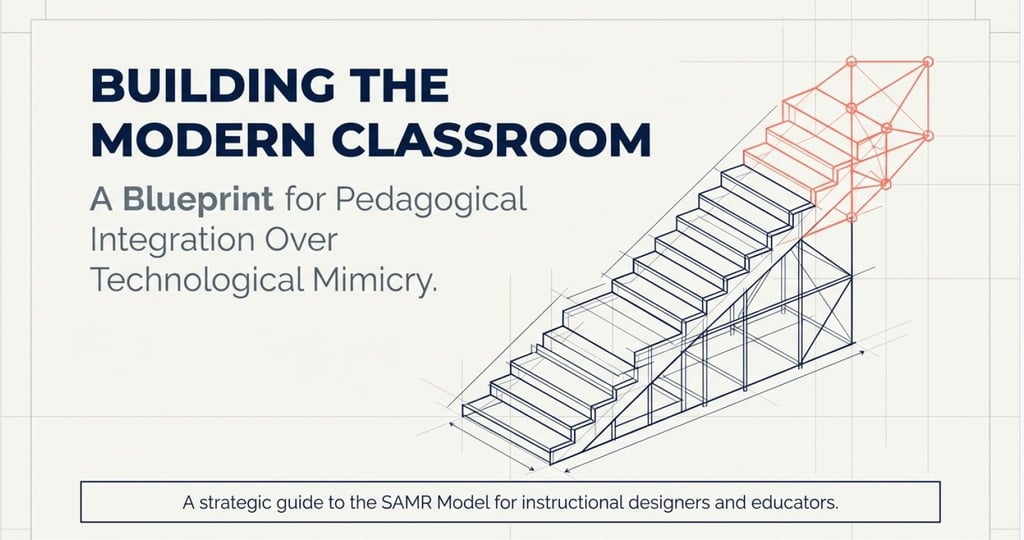
The SAMR model is a four-step ladder divided into two distinct phases. Below the "invisible line" lies Enhancement (Substitution and Augmentation), where technology improves existing tasks. Above the line lies Transformation (Modification and Redefinition), where technology fundamentally changes the nature of the learning experience. Crossing this line is critical for 21st-century learners, moving them from basic comprehension to higher-order thinking skills like problem-solving and critical analysis.
Enhancement (S & A)
Substitution: Tech acts as a direct substitute with no functional change (e.g., typing an essay). Benefit: Digital reusability across platforms.
Augmentation: Tech acts as a substitute with functional improvements (e.g., using real-time grammar and spell-check tools).
Core Goal: Engagement & Innovation
Transformation (M & R)
Modification: Tech allows for significant task redesign (e.g., publishing an essay to a blog for global peer review).
Redefinition: Tech allows for the creation of new tasks previously inconceivable (e.g., co-creating projects with international schools).
Core Goal: Efficiency & Productivity
4. Redesigning the Impossible: The Power of Modification and Redefinition
At the higher rungs of the ladder, technology enables "previously inconceivable" activities. This shift elevates the student’s role from a passive "seeker" of information to an active "creator" or "researcher," aligning with the NEP 2020 goal of experiential learning.
Modification: In this stage, a standard task is redesigned for wider impact. For example, rather than presenting an analysis only to a teacher, a student posts it to a blog to receive global feedback. This fosters multicultural competence as students engage with diverse perspectives from across the globe.
Redefinition: This is the pinnacle of the framework. Real-world examples include using Python programming to model and predict local traffic patterns or using video conferencing to bring a scientist directly into the classroom to discuss nuclear reactor safety. Even a simple seed growth project is redefined when students use time-lapse video capture to observe and explain minute biological developments that are impossible to see with the naked eye.
5. The AI Trap: Copilot vs. Autopilot
The rise of Large Language Models (LLMs) and AI presents a new pedagogical challenge: maintaining student agency. If technology is used as an "autopilot," where AI performs the cognitive heavy lifting, it becomes a barrier to development. Instead, technology must function as a "copilot." Educators must design assignments where students remain the primary drivers, using AI to visualize, analyze, or validate information rather than replace their own thinking. Student involvement is the vital ingredient that prevents high-end tech from becoming a hollow exercise.
6. The Pedagogical Pivot: From Behaviorism to Connectivism
As a teacher ascends the SAMR ladder, their underlying philosophy must evolve. This progression represents a "measurable professional growth" that changes the very nature of instruction:
The Operator (Substitution/Augmentation): Reflects a Behaviorist approach. The focus is on content delivery, fluency, and replacing older tools with digital ones for better efficiency.
The Facilitator (Modification): Moves toward Constructivism. The teacher facilitates interactive experiences where students begin to build their own knowledge through feedback and multimedia.
The Designer (Redefinition): Embraces Connectivism. The teacher becomes an instructional designer, creating environments for original research, co-creation, and global collaboration.
7. Conclusion: Start with "Why," Not "What"
To avoid the overwhelm of the "app explosion," educators should focus on a few meaningful tools and use them flexibly across the SAMR levels. The most effective strategy is to follow these best practices:
Start with a "Why": Begin your lesson planning with a case, scenario, or situation that triggers inquiry, rather than just a tool.
Focus on Gains: Ask what is being "gained" by using the tool. If there is no functional or pedagogical gain, the technology is unnecessary.
Iterative Reflection: Regularly evaluate how the technology influenced student participation and learning outcomes.
The SAMR ladder is a flexible guide, not a rigid mandate. You do not need to reach "Redefinition" in every lesson, but you should always be aware of your position on the ladder.
As you plan your next lesson, evaluate it through the lens of transformation: Are you simply digitizing a traditional task, or are you creating a learning experience that would be impossible without the screen?